The Market Context: The Critical Need for Storage
As India races towards its renewable energy targets, the grid faces a new challenge: intermittency. Solar generates power only during the day, creating a “Duck Curve” where supply peaks when demand might be low. To fix this, the government is aggressively pushing for Battery Energy Storage Systems (BESS). This emerging sector is the next frontier for power companies, and KPI Green Energy (NSE: KPIGREEN) has just announced its grand entry into this high-growth space.
Strategic Win: A “First” for the Group
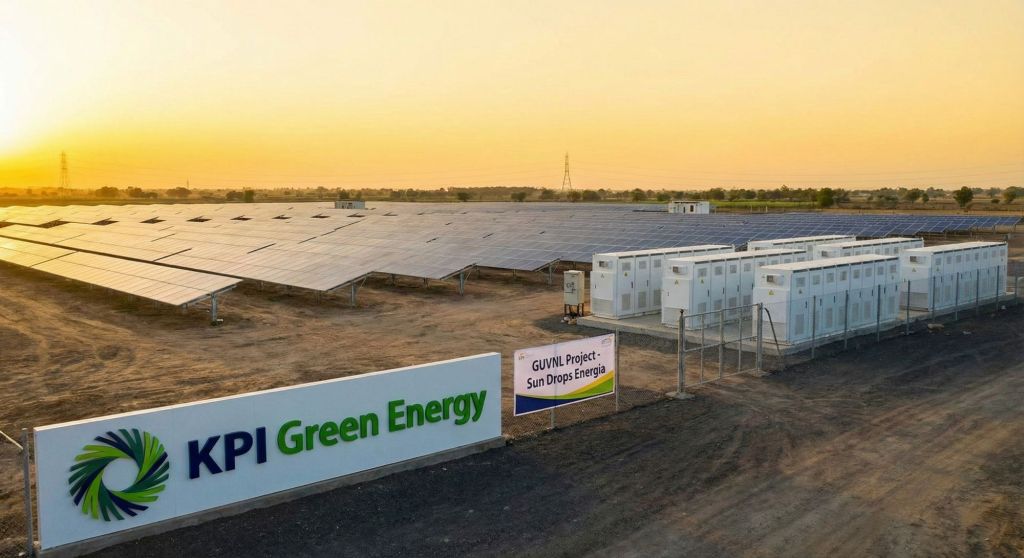
KPI Green Energy has achieved a significant milestone by receiving a Letter of Intent (LoI) from Gujarat Urja Vikas Nigam Limited (GUVNL). The order was awarded to its wholly-owned subsidiary, Sun Drops Energia Private Limited. This is not just another solar order; it is the group’s first utility-scale Standalone BESS project. By securing this mandate, KPI Green Energy transitions from a pure-play renewable generator to a comprehensive “dispatchable green power” solution provider, capable of storing energy and releasing it during peak demand hours.
Deep Dive: Capacity and Impact
According to the official exchange filing, the scale of this project is massive, involving the development of 445 MW / 890 MWh of self-owned Independent Power Producer (IPP) Standalone BESS projects. While the specific CapEx figures are typically determined by the tariff-based competitive bidding process, a project of this magnitude—nearly 1 Gigawatt-hour (GWh) of storage potential—represents a substantial addition to the company’s asset block. It positions KPI Green Energy among the elite few Indian players capable of executing GWh-scale storage infrastructure.
Conclusion & Investment Implication
This win is a clear signal that KPI Green Energy is future-proofing its business model. Storage is the “holy grail” of the renewable transition, and securing a marquee client like GUVNL for a debut project significantly de-risks the entry. For investors, this marks the beginning of a new revenue stream beyond traditional solar/wind generation.
 Tatkal Times